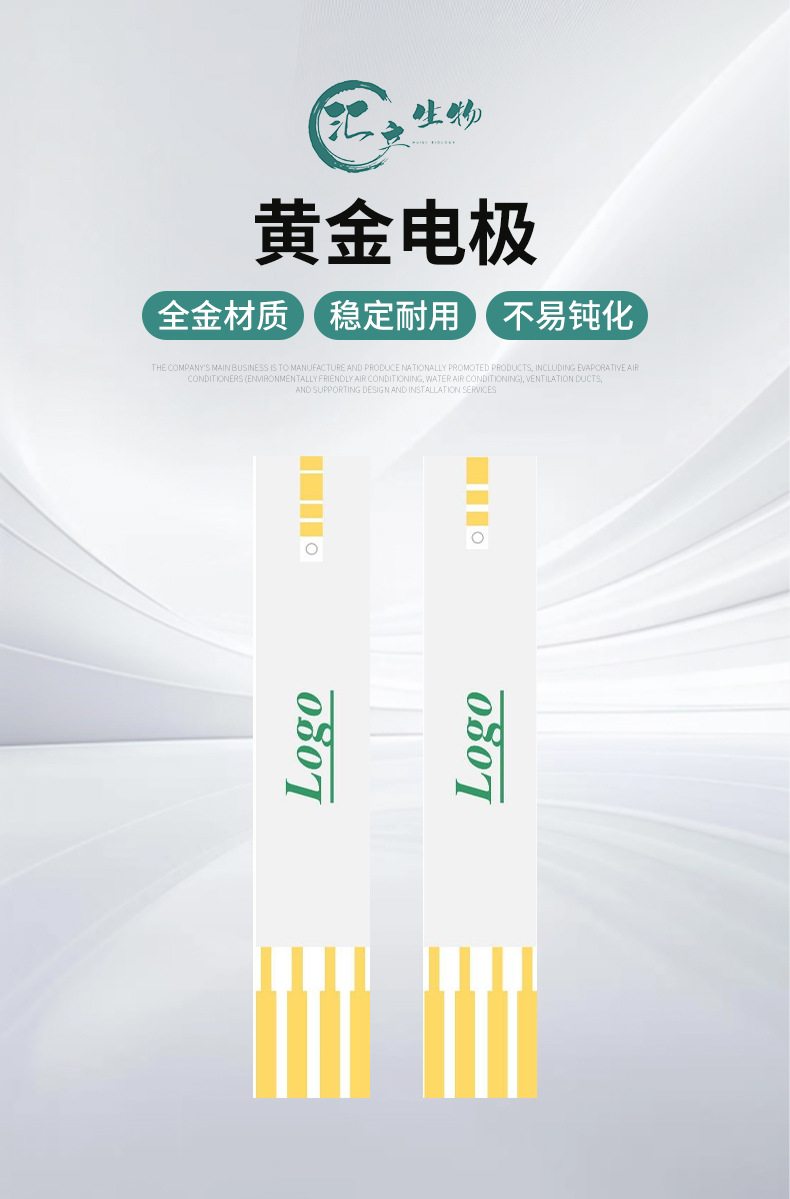
Sputtered Gold Electrode Sensors
Deposited from high-purity gold (Au ≥ 99.99%) target material via magnetron sputtering, delivering excellent conductivity, chemical stability, and biocompatibility. Widely used in blood glucose monitoring, continuous glucose monitoring (CGM), electrochemical immunoassay, and other fields.
Technical Specifications
| Parameter | Specification |
|---|---|
| Electrode Material | High-purity gold (Au ≥ 99.99%) |
| Deposition Method | Magnetron Sputtering |
| Film Thickness Range | 50-500 nm (customizable) |
| Substrate Options | PET / PI / Ceramic (optional) |
| Electrode Dimensions | Customized per customer drawings |
| Sheet Resistance | ≤ 5 Ω/sq (typical) |
| Chemical Stability | Excellent oxidation and corrosion resistance |
| Biocompatibility | Meets biocompatibility testing requirements |
| Environmental Compliance | RoHS and REACH compliant |
Key Advantages
1. Excellent Conductivity
Gold offers one of the highest electrical conductivities of all metals. Sputter-deposited gold films feature low resistivity and stable signal transmission, making them ideal for the precise detection of weak electrochemical signals.
2. Outstanding Chemical Stability
Gold does not react with oxygen at room temperature and is extremely resistant to oxidation. The electrode surface resists passivation and maintains stable long-term performance, making it ideal for CGM systems that require continuous monitoring.
3. Excellent Biocompatibility
Gold electrode surfaces are highly biocompatible and can come into direct contact with blood and interstitial fluid without triggering significant immune responses, making them suitable for implantable and wearable sensing applications.
4. Nano-Scale Deposition Precision
Magnetron sputtering enables nano-scale film-thickness control. The electrode films are uniform, dense, and strongly adherent, meeting the stringent requirements of high-precision electrochemical detection.
Applications
- Blood Glucose Monitoring: serving as the core working electrode of glucose test strips for home glucose meters and hospital POCT glucose testing
- Continuous Glucose Monitoring (CGM): used in the sensor probes of CGM systems to enable 7-14 days of continuous glucose monitoring
- Electrochemical Immunoassay: acting as the signal transduction layer of immunosensors for the quantitative detection of antigen-antibody reactions
- Uric Acid Testing: uricase-modified electrodes for monitoring hyperuricemia and gout
- Lactate Testing: lactate-oxidase-modified electrodes for sports medicine and intensive care
Comparison with Conventional Electroplated Gold Electrodes
| Comparison Item | Magnetron-Sputtered Gold Electrode | Conventional Electroplated Gold Electrode |
|---|---|---|
| Film Uniformity | Extremely high, nano-scale precision | Moderate, large thickness variation |
| Adhesion | Strong, bonding force >3N | Moderate, prone to peeling |
| Chemical Purity | High, Au ≥ 99.99% | Moderate, contains impurities |
| Environmental Impact | Vacuum process, pollution-free | Cyanide-containing waste liquid |
| Batch Consistency | CV ≤ 5% | CV 10-15% |
| Customization Flexibility | High, adjustable film thickness/dimensions | Low, limited by the process |
Customization Services
Huili Biotech provides OEM/ODM customization services for sputtered gold electrodes, including:
- Metal options: gold, gold-platinum alloys, gold-silver alloys, and more
- Film thickness customization: deposition thickness tuned to the application
- Dimension customization: non-standard sizes and complex electrode geometries supported
- Substrate customization: PET, PI, ceramic, silicon wafers, and more
- Enzyme immobilization: glucose oxidase, uricase, lactate oxidase, and more
- Packaging options: single pieces, reel-to-reel tape, trays, and more